
An innovative peer-reviewed study in the scientific journal Mindfulness has described, for the
First time, exactly when various brain changes occur moment-to-moment chronologically during meditation. This study was carried out by a team of neuroscientists from Harvard Medical School, NIMHANS, the University of Liège, and the University of Ottawa, who used high-density 128-channel electroencephalogram (EEG) readings to examine brainwaves in over 100 subjects. It is a proven fact that meditation causes brain wave changes much more quickly than we have hitherto known.
The Two-Minute Shift

During the course of our normal day or during the act of multitasking and working, our brain functions mainly with Beta waves (12–30 Hz) that correspond to logical thinking, problem solving, and anxiety. It is from the second minute onwards of breath-watching that the brain starts going through an Alpha wave (8–12 Hz) state. Alpha waves are a state of relaxed alertness.
The Seven-Minute Peak

Knowing that the period during which the peak intensity of brainwave variations takes place is from 7 to 10 minutes, whether you have previous experience or not, shows that mindfulness is accessible to anyone. It demonstrates that the capability of the brain to engage in deep meditation is a biological function.
Instantaneous Accessibility for Beginners

This fast-paced change in the brain not only happens to spiritual masters, but also to complete beginners without any past knowledge, and can also be observed having similar and significant changes in brainwaves in the same single-digit minutes.
30-Seconds Signature of Masters

“30 Second Signature of the Masters” is an example of the greatest form of neuroplasticity and cognitive control. Whereas a beginner needs to struggle against mental resistance and spend minutes clearing out thoughts from his mind, the expert has already created an extremely effective “neurochemical superhighway”.
Regulating the Deepest Regions of the Brain
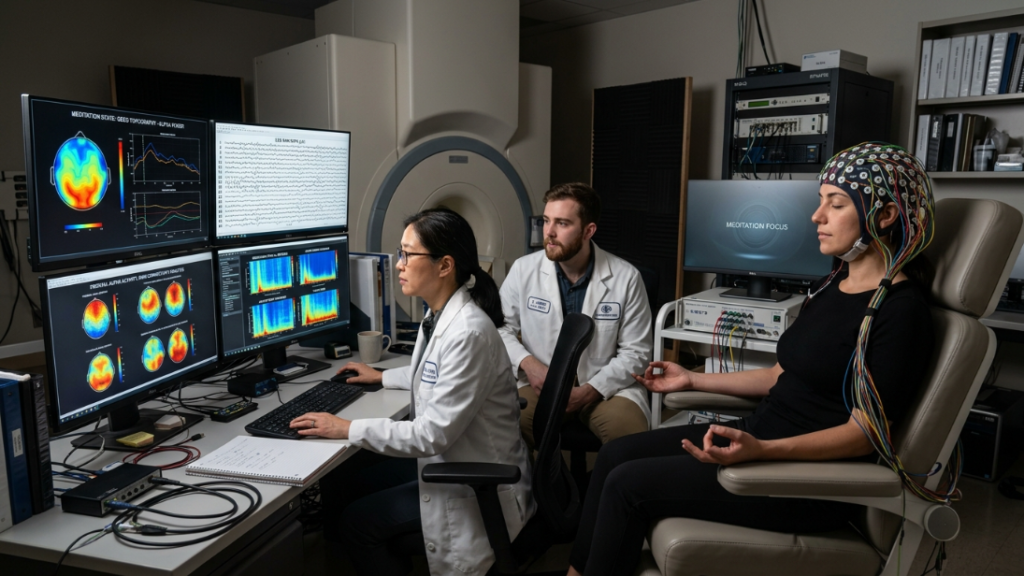
A study published by the Icahn School of Medicine at Mount Sinai in PNAS demonstrates that rapid changes in brain wave activity in the cortical areas have direct effects on activity in deeper regions such as the amygdala and hippocampus.
Reducting the Emotional Alarm System

Due to the quick adaptation in neural networks in the amygdala, the Beta and Gamma waves’ intensity and lifespan are quickly adjusted. As both types of brain waves tend to be greatly disturbed in the case of mood-related disorders, it leads to voluntary adjustment of them within minutes, effectively reducing activity in the brain’s emotional alarm system.
Engagement of the Memory Center

As the brain’s internal activity starts synchronizing quickly, its effects reach the hippocampus. That’s how it is possible for daily meditation practices to become helpful for better memory formation and space perception abilities.
Attaining Brain Criticality

Using advanced signal processing, it can be seen that meditation is capable of pushing the brain into “criticality,” i.e., achieving proper balance between the utter chaos of neural activity and absolute order. Thus, data processing becomes more efficient, and brain functions can easily adjust.
Validation of Breath Watching

Objective data was collected using the Miracle of Mind method of breath watching meditation practice. In other words, it is confirmed that focusing on breathing and bringing one’s attention back to it in case of distraction works just fine.
